

.
In a previous blog (here) we explored how bees can detect subtle changes in the electric fields surrounding flowers, helping them identify which flowers have recently been visited by other bees. For centuries, people observed bees moving from flower to flower without realizing that electric fields were part of the process.
The communication was always there. We simply did not know it existed.
As scientific knowledge advances, we continue to discover that nature is far more interconnected than it first appears.
What if I told you that some plants can detect when an insect is chewing on their leaves? Or that nearby plants may begin preparing their defenses before they are attacked?
These are not new abilities. Plants have been doing this for millions of years. We are only now beginning to understand the mechanisms behind them.
.
When a Caterpillar Takes a Bite
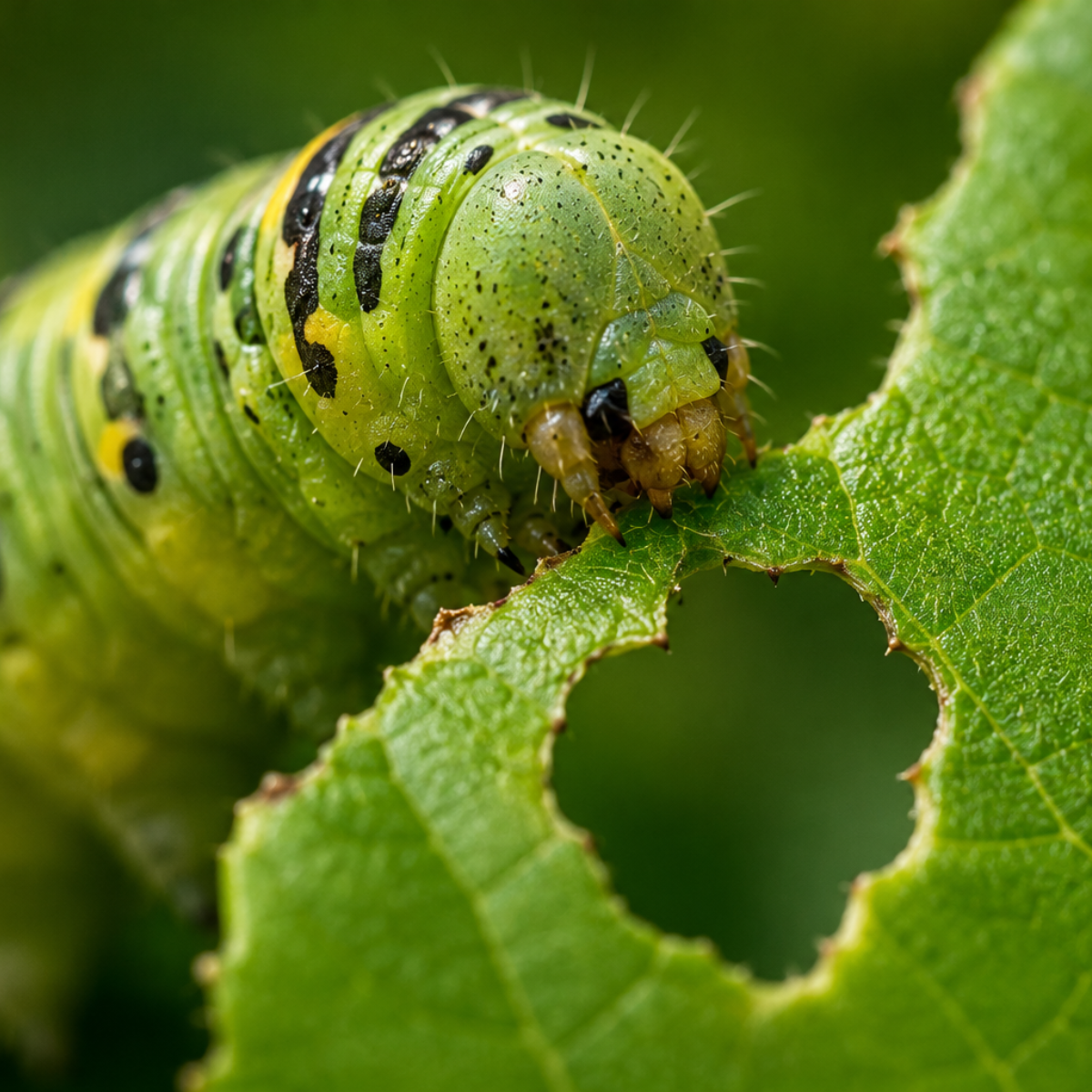
Imagine a caterpillar landing on a leaf and taking its first bite.
At first glance, the plant appears defenseless. Unlike animals, plants cannot run away, hide, or physically fight back against predators.
For many years, scientists viewed plants as passive organisms that simply endured whatever happened to them.
The development of advanced technologies, from high-resolution microscopes to molecular analysis and sensitive electronic sensors, has revealed that plants are far more responsive to their environment than scientists once believed.
Many of nature’s processes were not discovered because they are new, but because advances in technology finally allowed us to observe them.
What we are learning today is not that plants have suddenly developed these abilities. Rather, we are uncovering communication systems and responses that have existed for millions of years.
When an insect damages a leaf, the plant immediately detects the injury. Damaged cells release chemical signals that spread throughout the plant, alerting other tissues that an attack is underway.
In a sense, the plant recognizes that something in its environment has changed and begins responding accordingly.
.
A Plant’s Internal Alarm System
One of the key signaling molecules involved in this process is a plant hormone called jasmonic acid.
When a plant is attacked, levels of jasmonic acid increase, triggering a variety of defense responses.
These responses may include:
- Producing chemicals that make the leaves taste bitter.
- Reducing the nutritional value of the damaged tissue.
- Creating compounds that slow the growth of certain insects.
- Strengthening plant tissues to make feeding more difficult.
Remarkably, these signals can travel to parts of the plant that have not yet been attacked, allowing them to prepare in advance.
What makes this possible is that plant cells contain specialized receptors capable of detecting specific chemical signals and activating defensive responses.
.
Calling for Help
The story becomes even more fascinating.
Some plants do more than defend themselves, they recruit allies.
When attacked by certain insects, plants can release airborne chemicals known as volatile organic compounds (VOCs).
These chemicals drift through the air and can attract predators of the attacking insect.
For example, when caterpillars feed on some plants, the plant releases chemicals that attract parasitic wasps. The wasps locate the caterpillars and lay their eggs on or near them, reducing further damage to the plant.
What appears to be a simple interaction between a leaf and a caterpillar is actually part of a much larger ecological interaction involving plants, insects, predators, and the surrounding environment.
.

.
Warning the Neighbors
The story becomes even more remarkable.
Research has shown that some plants can detect chemical compounds released by neighboring plants under attack. When these compounds are detected, nearby plants may begin activating their own defensive responses before insects arrive.
Plants do not “smell” danger in the way animals do. Instead, their cells contain specialized receptor proteins capable of recognizing certain molecules in the environment. When these molecules are detected, a series of internal chemical reactions is triggered, preparing the plant for a potential threat.
No words are exchanged.
No sounds are made.
Yet information is being transferred from one organism to another.
.
The Hidden Network Beneath Our Feet
Communication in nature does not occur only above ground.
Beneath forests, fields, and gardens lies a vast network of fungi connected to plant roots.
These fungal networks help plants absorb water and nutrients. While this role is well established, scientists are still investigating whether fungal networks also contribute to communication between plants and, if so, to what extent.
What is already clear is that ecosystems are shaped by countless interactions occurring simultaneously among living organisms and their environment.
.
Nature’s Many Languages
The more scientists study living organisms, the more they discover that information can be transmitted through many different types of signals.
Flowers and bees exchange information through electric fields.
Plants respond to insect attacks through chemical signals.
Birds communicate through songs.
Many animals use scent markers to share information about territory, danger, or reproduction.
Information flows continuously through ecosystems, often in ways that are invisible to us.
Communication in nature is not limited to words or sounds. Living organisms exchange information through a variety of signals, many of which humans cannot directly perceive.
.
A Lesson from Nature
One of the most exciting aspects of science is discovering that the world is often far more complex than it appears.
A flower is not simply a flower.
A leaf is not simply a leaf.
Behind what seems like silence lies a constant exchange of information that helps living things survive, adapt, and maintain the balance of ecosystems.
The next time you see a caterpillar feeding on a leaf, remember that the conversation has already begun.
.
Think About It
In our previous blog, we discovered that bees can detect subtle changes in the electric fields surrounding flowers. In this blog, we explored how plants communicate through chemical signals.
What other communication systems might exist in nature that scientists have not yet discovered?
The natural world still holds many mysteries, and every new discovery reminds us that there is far more happening around us than meets the eye.