


Introduction
Flowers don’t have voices, and bees don’t receive instructions — yet bees consistently find the flowers that still contain nectar.
How?
The answer lies in something invisible: electric fields.
This fascinating scientific phenomenon is more than just an interesting fact. It highlights a deeper truth about learning — one that explains why many students struggle in math and science, even when they study.
The Science Behind It
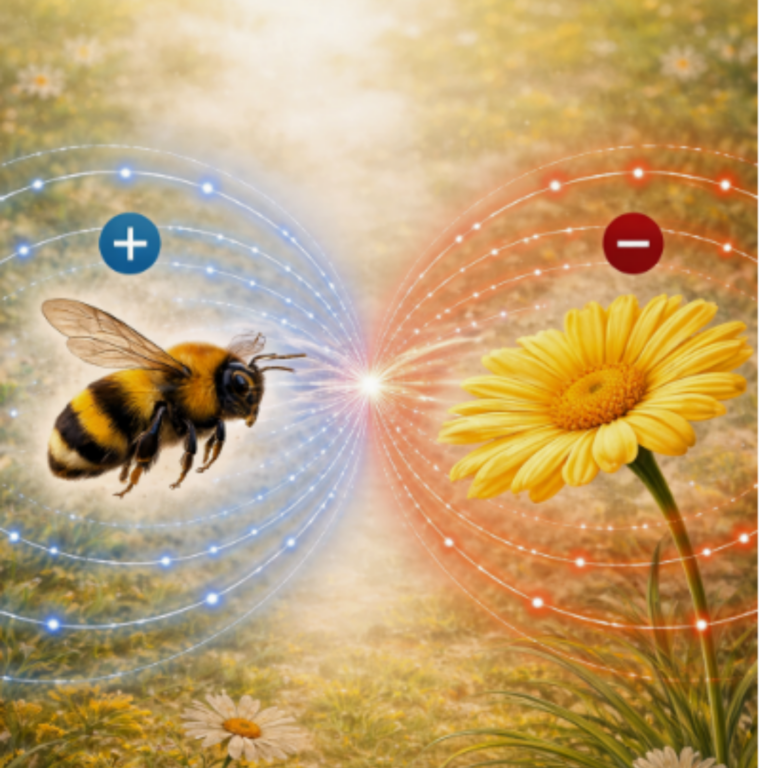
As bees fly, friction with air causes them to lose electrons and become positively charged. This process is known as the triboelectric effect.
Flowers, on the other hand, are connected to the ground through their stems and roots. The Earth supplies electrons, giving flowers a negative charge. This process is called grounding.
When a positively charged bee approaches a negatively charged flower, an electric field forms between them.

The Science Behind It
As bees fly, friction with air causes them to lose electrons and become positively charged. This process is known as the triboelectric effect.
Flowers, on the other hand, are connected to the ground through their stems and roots. The Earth supplies electrons, giving flowers a negative charge. This process is called grounding.
When a positively charged bee approaches a negatively charged flower, an electric field forms between them.
How Bees Detect Flowers
Bees don’t see these electric fields — they sense them.
Tiny mechanosensory hairs on their bodies respond to electric forces. When an electric field is present, these hairs bend slightly, allowing bees to detect invisible signals.
This helps bees determine which flowers are worth visiting.
What Happens After a Bee Visits a Flower?
When a bee lands on a flower, it transfers some of its charge.
As a result, the flower’s negative charge decreases, and the electric field becomes weaker.
This change makes the flower less detectable to other bees, signaling that it may already have been visited.
Why This Matters for Learning?
This example reveals something important:
Science is not just about memorizing formulas or definitions. It is about understanding how invisible systems shape real-world behavior.
Many students can follow examples in class or recognize solutions in their notes. But when they need to apply concepts independently — especially on tests — they struggle.
This is often due to a gap between recognition (familiarity) and true understanding (application).
A Common Learning Gap
In tutoring, we often see students who:
- complete homework correctly
- participate in class
- feel confident while reviewing
Yet their test results do not reflect that effort.
Because recognizing a concept is not the same as being able to retrieve and apply it independently.
How We Support Students
At STEM Tutorex, we focus on helping students:
- understand concepts at a deeper level
- connect ideas across topics
- develop independent problem-solving skills
This approach builds not only academic performance, but also confidence and long-term learning ability.
Conclusion
The natural world is full of systems we cannot see — but can understand with the right guidance.
When students move beyond memorization and start truly understanding, their performance changes.
If your child is working hard but not seeing the results they expect, there may be deeper learning gaps.
Book a complimentary consultation to explore how we can help.
Explore Further
Want to go deeper into this concept?
Download the worksheet here:
https://stemtutorex.com/wp-content/uploads/2026/04/Bees_Electric_Fields_Worksheet.pdf
You may also enjoy our article on how animals use mimicry, camouflage, and other natural disguises to survive.