

.
The ideas presented in this article have developed through more than 25 years of teaching experience in Ontario, as well as through tutoring and observing how students approach learning, respond to difficulties, and gradually develop greater independence. Some of these observations and real learning situations are discussed in a previous article. These experiences have shaped the Learning Skills Cycle presented here and are consistent with established research on metacognition and self-regulated learning.
.
At the beginning of a school year, attention naturally turns to academic content: new concepts, new expectations, and the areas in which a student may need additional support. Yet throughout my years of teaching and tutoring, I have found that understanding the content is only part of learning. Behind much of what students do at school are learning skills that may be less visible than academic knowledge but are equally important to the learning process.
Students need to process information, organize their thinking, plan an approach, select appropriate concepts and strategies, recognize when something is not working, and decide what to do next. We eventually expect them to perform many of these processes independently, but independence does not simply appear as students get older. The learning skills that make independence possible have to be developed.
.
From The Three Little Pigs to Learning Skills
In my previous article about The Three Little Pigs, I looked at the story from the perspective of mindset, focusing particularly on the skills demonstrated by each character and how those skills influenced their choices. The three pigs had the same general objective, building a house, but they approached the task differently. Their planning, decisions, use of available resources, and responses to difficulty influenced both the way they approached the task and what they eventually built.
I see a similar pattern with students. Two students can receive the same lesson and the same problem but approach it very differently. One may immediately search for a formula or try to produce an answer, while another first considers what the problem means, identifies the relevant information, connects it with previous learning, and then decides how to proceed. The difference is not simply academic knowledge; it also lies in the learning skills each student is able to bring to the task.
This leads to the question I want to explore here: How are these learning skills acquired, and how do they gradually become part of the way a student learns?
.
Learning a Skill Before Expecting Independence
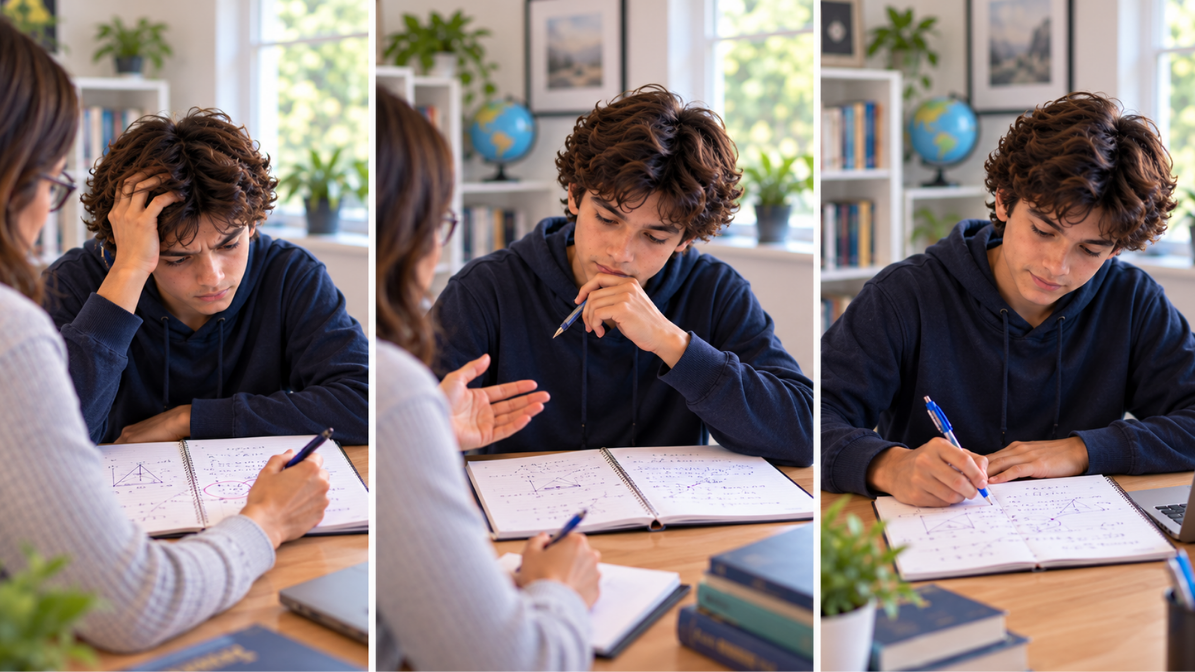
Consider a student who struggles with word problems. Telling the student to “read the question carefully” assumes that the student already knows what careful reading of a problem involves. An experienced problem solver may automatically identify the situation, distinguish relevant information from unnecessary details, determine what needs to be found, and connect the problem with previously learned concepts. A student who has not yet developed those skills may simply see a paragraph containing words and numbers.
In that situation, I may need to make the thinking process explicit. I can guide the student to identify what is happening, what information is given, what needs to be determined, which information is relevant, and what previous knowledge might be useful. Initially, much of that thinking is prompted by the teacher or tutor because the student is still learning the process.
An explanation or demonstration, however, does not mean that the skill has been acquired. The student needs opportunities to apply it with guidance and to repeat the process in different situations. As the student becomes more capable of using the skill, the amount of guidance can gradually be reduced until it is no longer needed for the student to apply that skill independently in that context.
I think of this as holding a student’s hand while the skill develops. We do not let go suddenly because the process has been explained once, but neither do we continue holding on after the student can proceed independently. The support changes in response to what the student is able to do.
This progression is consistent with research on metacognition and self-regulated learning, which emphasizes explicit instruction, modeling, guided practice, scaffolding, and progressively more independent use of strategies.
.
From External Questions to Independent Thinking
One indication that a skill is developing is a change in who initiates the thinking. At first, I may have to ask a student what the question is asking, which information is relevant, or whether an answer makes sense. With repeated practice, the student begins to initiate this thinking without waiting for me.
This change is more significant than simply remembering a list of prompts. A thinking process that initially required external prompting is gradually becoming part of the student’s own approach to the task.
This is why independence should not be interpreted as evidence that guidance was unnecessary. Appropriate guidance helps the skill develop to the point at which the student no longer needs that guidance to use it. What becomes internalized is the skill and the thinking process; the external support used to develop them is gradually reduced as it becomes less necessary.
.
The Learning Skills Cycle
Based on what I have observed through teaching and tutoring, I represent this development through what I call The Learning Skills Cycle:
Learn → Apply → Reassess → Reflect → Adjust → Apply again
.
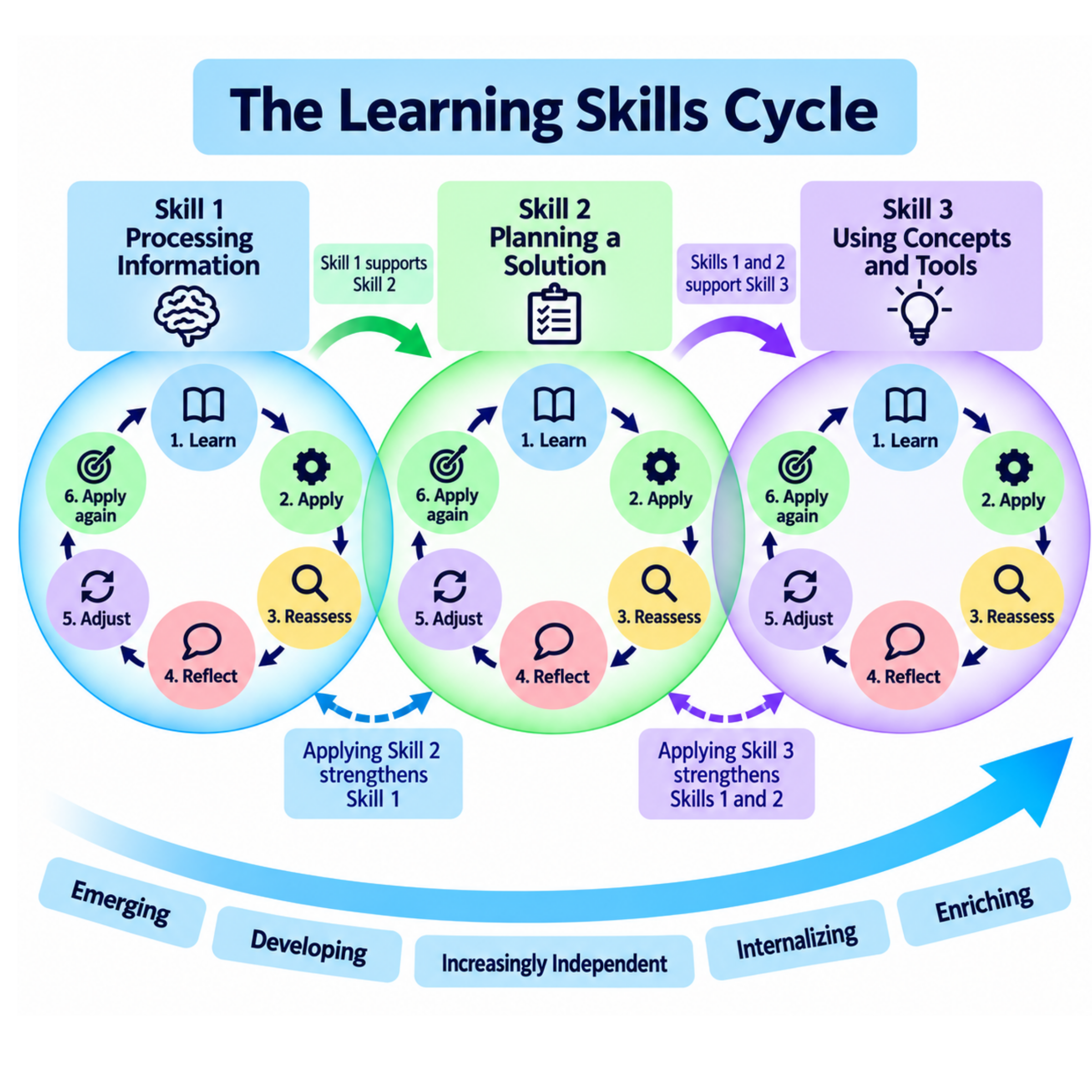
Learning introduces the skill and its purpose. Application gives the student an opportunity to use it, initially with whatever level of guidance is necessary. As the student applies the skill, their performance reveals what they can already do independently, where guidance is still needed, and what may require further practice.
Reassessment identifies where the student is now: what worked, what has improved, and where difficulty remains. Reflection examines the process more closely by considering why an approach worked or why difficulty occurred. Adjustment uses that information to decide what needs to change before the skill is applied again.
Applying again is not simply repetition. The student applies the skill again after reassessment and reflection have identified what worked and what needs to change. A misunderstanding may have been identified, a strategy may need to be modified, or the student may now be ready to complete more of the process without assistance. Each new application provides another opportunity for the skill to develop.
The cyclical nature of this framework is consistent with research on self-regulated learning. Models such as Zimmerman’s describe learning through recurring processes of planning, performance, monitoring, and reflection, in which one experience influences how the learner approaches the next. The Learning Skills Cycle is not a reproduction of one of these research models; it is a STEM TUTOREX framework developed from my teaching experience and observations.
Skills Develop Together
Learning skills do not develop as a checklist in which one skill must be completely mastered before another can begin. In practice, their development overlaps, and the application of a newer skill often requires the continued use of skills introduced earlier.
Take three skills involved in problem solving: processing information, planning a solution, and using concepts and tools. A student may initially need considerable guidance to process the information in a problem. As that ability develops, planning a solution can be introduced. Planning, however, still requires the student to process the information, so the first skill continues to be practised while the second is developing.
When the student begins learning how to select and use appropriate concepts, formulas, representations, or tools, both earlier skills are needed. The student must understand the information before planning an approach and must have an approach in mind before deciding which mathematical or scientific tools are appropriate. Each time the third skill is applied, the first two are also being used and further strengthened.
With enough practice, earlier skills become integrated into the larger process rather than remaining separate steps that require individual prompts. A student may therefore be learning one skill, developing another, and internalizing an earlier one at the same time. This is why I see learning-skills development as overlapping rather than linear.
In the Learning Skills Cycle, I represent the development of an individual skill as:
Emerging → Developing → Increasingly Independent → Internalizing → Enriching
These stages apply to individual skills, not to the student as a whole. A student may independently use one learning skill while still requiring considerable guidance with another, and the level of independence can also change when the same skill is applied in a more demanding context.
.
Internalizing a Skill Is Not the End
I deliberately included Enriching after Internalizing because being able to use a skill independently does not mean that the skill has finished developing. As students encounter more complex or unfamiliar situations, they learn to adapt skills they already use independently rather than apply them in exactly the same way each time. The skill retains its underlying structure, but its application can branch in different directions depending on the information available, the context, and what the student is trying to accomplish.
Processing information provides a good example. At an earlier stage, a student may be learning to identify the information given and what needs to be determined. Later, the same skill may involve distinguishing relevant information from unnecessary details, recognizing relationships between pieces of information, identifying what may be missing, questioning assumptions, and making connections with prior knowledge.
The underlying skill is still processing information, but the student has become more flexible in adapting it to the demands of the situation. A process that is sufficient for a straightforward mathematics problem may need to be adjusted when a student encounters a situation involving unfamiliar information, several variables, implicit information, or different possible approaches.
Enrichment also means extending the use of learning skills beyond the task or subject in which they were first developed. Students can learn to use these skills to assess their own knowledge and understanding: recognizing what they know, identifying gaps, questioning their assumptions, and deciding whether they need more information, practice, clarification, or a different approach. This ability to think about and regulate one’s own learning is part of metacognition.
The value of these learning skills extends well beyond school. The ability to assess what we know, recognize what we still need to learn, reflect on an approach, and adjust when necessary can be transferred to further education and career development, applied in the workplace, and relied upon in responsibilities and decision-making within family and community life. The situations will change, but the underlying learning skills remain essential for understanding new information, assessing one’s own knowledge, making informed decisions, adapting to new demands, and determining what needs to be learned next.
Internalization allows the student to use a skill independently. Enrichment broadens and deepens its use by allowing the student to adapt it to increasingly varied purposes, demands, and contexts, both within school and throughout life.
.
Schoolwork Provides the Practice
Homework, studying, problem solving, and assignments provide the situations in which learning skills can be taught, practised, connected, and gradually applied with greater independence.
The objective is not to teach a collection of abstract “learning skills” disconnected from academic content. Students need opportunities to develop them while doing meaningful academic work. The school task provides the context; the learning skill is what the student can carry forward.
Homework: Learning From the Work
When homework is approached only as something that must be completed, a wrong answer is simply an obstacle to finishing the page. When students learn to monitor their own understanding, a wrong answer can instead provide information about where the difficulty lies.
The useful question is not only What is the correct answer? but Why was my answer incorrect? A conceptual misunderstanding, a misread question, an inappropriate strategy, and a calculation error are different problems and require different responses. Learning to make that distinction helps the student decide what to do next rather than simply replacing a wrong answer with a correct one.
The objective is not to make homework slower. A student with well-developed skills may work very efficiently. The distinction is between completing work quickly because the process is understood and rushing toward completion without knowing whether the work reflects understanding.
Studying: Deciding What Needs Attention
Studying requires students to assess their own knowledge and make decisions about where to direct their effort. One way I help students practise this is by organizing the concepts they are studying into three categories:
Well understood | Partially understood | Not understood yet
The purpose is not to assign another grade but to determine what kind of action each concept requires. A concept that is not understood yet may require another explanation or a return to prerequisite knowledge. A partially understood concept may require focused practice, while a concept considered well understood can be tested through recall or application without relying on notes.
After studying and practising, the student assesses each concept again. What was initially only partially understood may now be well understood, while practice may reveal that something the student thought was well understood still needs attention. In this way, the student learns to use evidence from their own performance to evaluate their knowledge and decide what to study next.
The choice of study strategy also matters. Recognizing material while rereading notes does not provide the same evidence of learning as being able to retrieve, explain, or apply it independently. Research into commonly used study techniques has similarly found stronger evidence for strategies such as practice testing and distributed practice than for relying primarily on rereading or highlighting.
Problem Solving: Connecting the Skills
Problem solving makes the relationship between different learning skills particularly visible. Before choosing a formula or beginning calculations, the student needs to process the information and understand the situation: what is known, what needs to be determined, which information is relevant, and how the information is connected.
Once the student has processed the information and has a clear understanding of what is known and what needs to be determined, that understanding becomes the basis for planning a solution. The student can then decide how to move from what is known to what needs to be found. An intermediate step may be necessary, or a diagram, table, graph, or other representation may help clarify the relationships. The student can also consider whether the situation resembles something previously encountered and which concepts may apply.
With the problem understood and an approach planned, the student can then determine which concepts and tools are appropriate for carrying out that plan. Instead of searching for a formula simply because it contains familiar variables, the student selects a mathematical relationship, scientific concept, representation, or other tool because it fits both the situation and the planned approach.
Initially, this process may require several prompts. With practice, the separate skills become increasingly connected until the student can approach a new problem without waiting for someone else to organize the thinking. The goal is not to memorize a fixed problem-solving checklist but to develop the skills needed to make appropriate decisions when the problem changes.
Assignments and Projects: Managing a Larger Process
Assignments and projects require many of the same skills over a longer period. Before beginning, the student needs to understand the task, its requirements, and the rubric. Planning determines what needs to be done and in what order, while research involves selecting relevant and reliable information and recording references as sources are chosen.
Organizing the information and jotting down ideas leads into drafting, but the process does not necessarily continue in a straight line. While reviewing a draft, the student may identify a gap and return to the research, reorganize part of the argument, or modify the original plan. Returning to an earlier stage is not necessarily evidence of poor planning; it can show that the student is evaluating the work and responding to what that evaluation reveals.
The process might therefore move through:
Understand → Plan → Research and record sources → Organize → Draft → Evaluate → Research further if necessary → Revise → Finalize
Once the assignment is completed, feedback and reflection help the student identify what worked, what needs improvement, and what should be done differently in the next assignment. With each cycle, the skills become sharper and the student becomes better able to apply them independently.
.
Learning to Transfer Skills
An important part of learning is being able to use knowledge and skills beyond the situation in which they were first developed. A student may learn to process information while solving mathematics problems, but using that skill in physics requires recognizing that the new situation calls for a similar way of thinking. Planning developed through a science investigation may later support a research assignment, but the student has to determine which elements of that planning process are relevant and how they need to be adapted.
Learning to transfer knowledge and skills is therefore an important ability in itself. It requires students to analyze a new situation, recognize connections with what they already know, identify similarities and differences, and decide which knowledge or skills may be relevant. They must then determine how that previous learning needs to be adapted to the new context rather than simply reproduce a familiar procedure and assume that it will fit.
Developing this ability is particularly important because students will continually encounter situations that are not identical to those in which they originally learned a concept or skill. The stronger their ability to make connections, analyze new situations, and adapt previous learning, the less dependent they become on being shown exactly what to do each time. Transfer therefore draws on analytical and critical-thinking skills while also contributing directly to greater independence as a learner.
.
What This Means for Parents
When a child asks for help, it is natural to focus on the immediate problem, particularly when homework needs to be completed or a test is approaching. Sometimes the student does need an explanation. At other times, questions such as What do you understand so far?, Where did you get stuck?, or What have you already tried? can help determine whether the student is struggling with the academic concept itself or with how they are approaching the task.
The amount of help should depend on what the student can currently do. A student acquiring a new skill may need substantial guidance, while another may need only a prompt before continuing independently. The objective is neither to leave the student struggling without a safety net nor to do so much of the thinking that the student has no opportunity to practise the skill.
Independent learning also does not mean never asking for help. Recognizing that information is missing, that a concept is not understood, or that several attempted approaches have failed shows that the student is monitoring the learning process. Knowing when help is needed and being able to identify what help is needed are themselves important learning skills.
.
Reassess. Reflect. Next.
The same three ideas can be used at the end of many learning experiences: Reassess. Reflect. Next. Reassessment establishes where the student is now, while reflection considers what contributed to the outcome. “Next” uses that information to determine what the student should do next.
Next does not necessarily mean moving on to another skill. It may mean applying the same skill again, changing the strategy, seeking clarification, working in a more complex context, or beginning another skill while continuing to strengthen an earlier one. The next step depends on what the student has learned from the previous one.
.
Building the Learner, Not Only Completing the Task
This brings me back to The Three Little Pigs. Building a house was the immediate goal, so the finished houses mattered. But as the story unfolds, the quality of each finished house reflects the process used to build it. The choices each pig made, the materials selected, and the way each approached the building process determined the strength of the final result.
The same distinction applies to schoolwork. Homework, tests, problems, and projects matter because they have an academic purpose and need to be completed. But from a learning perspective, the process is even more important. It is through that process that students identify what they understand and where they struggle, apply and develop learning skills, learn from mistakes, adjust their strategies, and improve.
A completed task gives us an outcome, but the quality of that outcome depends largely on the process that produced it. When students understand and increasingly internalize the learning skills involved in that process:
- how to interpret information,
- plan,
- make decisions,
- monitor their understanding,
- evaluate their work,
- adjust when necessary,
they are better equipped not only to improve the current outcome, but also to approach future tasks more effectively and independently.
Helping a student complete today’s work solves today’s immediate problem. Developing the learning skills behind that work helps the student approach tomorrow’s problem with greater independence.
That independence develops gradually through teaching, guided practice, reassessment, reflection, and repeated application. As the student’s ability develops, guidance can be reduced, while the skill itself can continue to be connected, adapted, transferred, and enriched in new contexts.
For me, this is the difference between simply helping a student finish the work and helping the student become a learner who increasingly knows how to approach the work.
.
Further Reading
The observations and framework presented in this article are consistent with a broader body of research on metacognition, self-regulated learning, scaffolding, transfer, and effective study strategies. Readers interested in exploring the research further may find the following resources helpful:
- Education Endowment Foundation — Metacognition and Self-Regulated Learning — Guidance on explicit teaching, modeling, scaffolding, metacognitive strategies, and the development of independent learners.
- Education Endowment Foundation — Metacognition and Self-Regulation, Teaching and Learning Toolkit — An overview of the evidence on metacognition and self-regulation in teaching and learning.
- Panadero — A Review of Self-Regulated Learning: Six Models and Four Directions for Research — A review of major self-regulated learning models, including cyclical processes of planning, performance, and reflection.
- Dunlosky et al. — Improving Students’ Learning With Effective Learning Techniques — A review comparing commonly used study techniques and the evidence supporting their effectiveness.
Images and diagrams in this article were created with the assistance of AI. The ideas and educational framework presented are based on the author’s teaching experience and observations.
The Learning Skills Cycle is an original STEM TUTOREX framework. It may be used and shared for educational purposes, provided that STEM TUTOREX is credited as the source.