

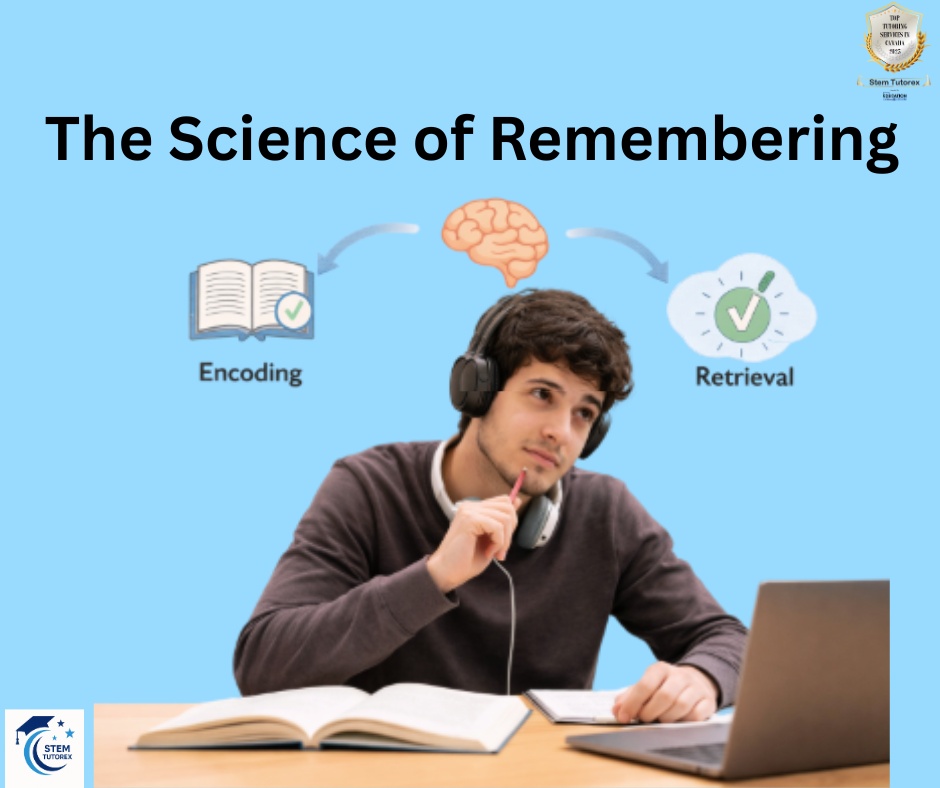
How the Brain Learns, Forgets, and Retains Information
Remembering is at the heart of learning, yet memory is not a perfect recording system. The science of remembering explains how the brain learns, stores, and retrieves information, and why we sometimes forget. At STEM Tutorex, we integrate the neuroscience of learning into every tutoring session, helping students not just memorize facts but truly retain and apply knowledge.

Understanding how memory works allows students to use strategies like active recall and spaced repetition, powerful research-backed methods that strengthen long-term retention and boost academic performance.
1- How Memory Works
Encoding is the process by which the brain transforms sensory input into mental representations. Craik and Lockhart’s (1972) Levels of Processing Framework demonstrated that deeper encoding, such as explaining, connecting, or applying new information, produces stronger memories than shallow repetition.
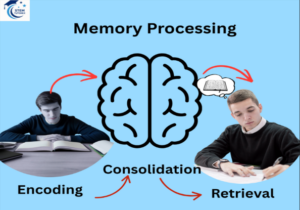
Once encoded, information undergoes consolidation, a biological process that stabilizes memory traces through synaptic and molecular changes (Dudai, 2004). During retrieval, Tulving and Thomson (1973) showed that memory is best when cues at recall match those present during encoding, a principle known as the encoding specificity principle.
2- Why We Forget
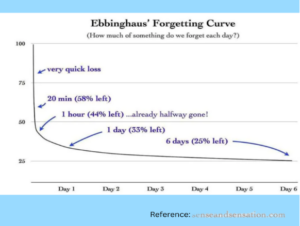
Ebbinghaus’s research in 1885 showed that memory decreases exponentially without review, as illustrated by the forgetting curve. Modern studies confirm that within days, learners can forget more than half of the new information if it is not revisited (Murre & Dros, 2015). Wixted (2004) indicated that forgetting is, in fact, part of how the brain prioritizes useful information.
Interference also plays a role in forgetting. Underwood (1957) and Anderson (2003) demonstrated that similar memories compete during retrieval, making recall more difficult. Context mismatches between learning and recall (Smith & Vela, 2001) also interfere with memory.
Even when information is well learned, recall can fail if the context in which retrieval occurs differs from the one in which learning initially took place. This is known as context-dependent memory. Smith and Vela (2001) demonstrated through a comprehensive meta-analysis that environmental context plays a significant role in recall. When learners study and later retrieve information in different settings, such as studying at home but testing in a classroom, recall performance often decreases.
The brain encodes not only the content being studied but also subtle contextual cues such as lighting, sounds, emotions, and even scents. These cues later act as retrieval triggers. When they are absent, access to the memory trace becomes weaker, resulting in temporary forgetting or the familiar ‘tip-of-the-tongue’ feeling.
However, context effects can also be used strategically. By recreating similar conditions during review and retrieval, such as using the same notes, the same time of day, or the same background sounds, students can strengthen cue overlap and improve recall. Alternatively, varying study environments intentionally can make memory more adaptable and less context-bound, a principle known as contextual variability.
For example:
– A student who studies math in a quiet room but writes tests in a bright classroom could occasionally review material in similar lighting to improve transfer.
– If a learner studies calmly but feels anxious during exams, simulating mild test pressure during practice can prepare the brain to recall under stress.
In practice, this means that memory is not only what we know, but also where and how we learned it. Understanding and applying this principle helps students and tutors design study strategies that enhance long-term retention and knowledge transfer.
3- The Neuroscience of Remembering
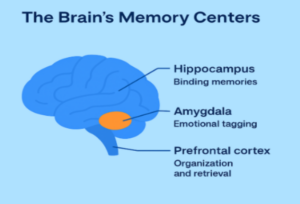
The hippocampus connects different experiences, while the prefrontal cortex organizes retrieval (Squire & Kandel, 2000). During sleep, replaying neural activity strengthens long-term memory (Dudai, 2004). Emotional arousal boosts storage through amygdala activation and hormonal modulation (McGaugh, 2013).
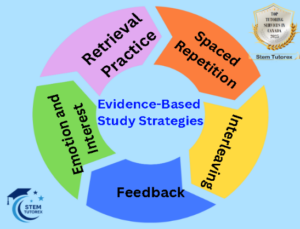
4- Evidence-Based Strategies to Strengthen Memory
Retrieval practice: Testing oneself boosts long-term retention more than rereading (Roediger & Karpicke, 2006).
Spaced repetition: Reviewing material over increasing intervals strengthens memory (Cepeda et al., 2006).
Interleaving: Mixing topics improves discrimination and deeper learning (Kornell & Bjork, 2008).
Elaboration: Explaining ideas in one’s own words creates rich, connected memory traces (Craik & Lockhart, 1972).
Feedback: Immediate correction prevents error reinforcement and builds metacognition (Dunlosky et al., 2013).
5- Practical Applications for Learners and Educators
- Plan spaced reviews (1 day, 3 days, 1 week, 1 month)
- Use self-testing (flashcards, quizzes, blurting)
- Mix practice (interleave math, chemistry, and physics)
- Explain concepts aloud
- Keep study cues consistent with test settings
- Connect learning to emotion and
References:
- Alberini, C. M. (2005). Mechanisms of memory stabilization: Are consolidation and reconsolidation similar or distinct processes? Trends in Neurosciences, 28(1), 51–56.
- Anderson, M. C. (2003). Rethinking interference theory: Executive control and the mechanisms of forgetting. Journal of Memory and Language, 49(4), 415–445.
- Cepeda, N. J., Pashler, H., Vul, E., Wixted, J. T., & Rohrer, D. (2006). Distributed practice in verbal recall tasks: A review and quantitative synthesis. Psychological Bulletin, 132(3), 354–380.
- Craik, F. I. M., & Lockhart, R. S. (1972). Levels of processing: A framework for memory research. Journal of Verbal Learning and Verbal Behaviour, 11(6), 671–684.
- Dudai, Y. (2004). The neurobiology of consolidations, or, how stable is the engram? Annual Review of Psychology, 55, 51–86.
- Dunlosky, J., Rawson, K. A., Marsh, E. J., Nathan, M. J., & Willingham, D. T. (2013). Improving students’ learning with effective learning techniques. Psychological Science in the Public Interest, 14(1), 4–58.
- Kornell, N., & Bjork, R. A. (2008). Learning concepts and categories: Is spacing the ‘enemy of induction’? Psychological Science, 19(6), 585–592.
- McGaugh, J. L. (2013). Making lasting memories: Remembering the significant. Proceedings of the National Academy of Sciences, 110(Suppl 2), 10402–10407.
- Murre, J. M. J., & Dros, J. (2015). Replication and analysis of Ebbinghaus’ forgetting curve. PLoS ONE, 10(7), e0120644.
- Roediger, H. L., & Karpicke, J. D. (2006). Test-enhanced learning: Taking memory tests improves long-term retention. Psychological Science, 17(3), 249–255.
- Smith, S. M., & Vela, E. (2001). Environmental context-dependent memory: A review and meta-analysis. Psychonomic Bulletin & Review, 8(2), 203–220.
- Squire, L. R., & Kandel, E. R. (2000). Memory: From Mind to Molecules. Scientific American Library.
- Tulving, E., & Thomson, D. M. (1973). Encoding specificity and retrieval processes in episodic memory. Psychological Review, 80(5), 352–373.
- Wixted, J. T. (2004). The psychology and neuroscience of forgetting. Annual Review of Psychology, 55, 235–269.