

.
A Sunflower Through an Artist’s Eyes
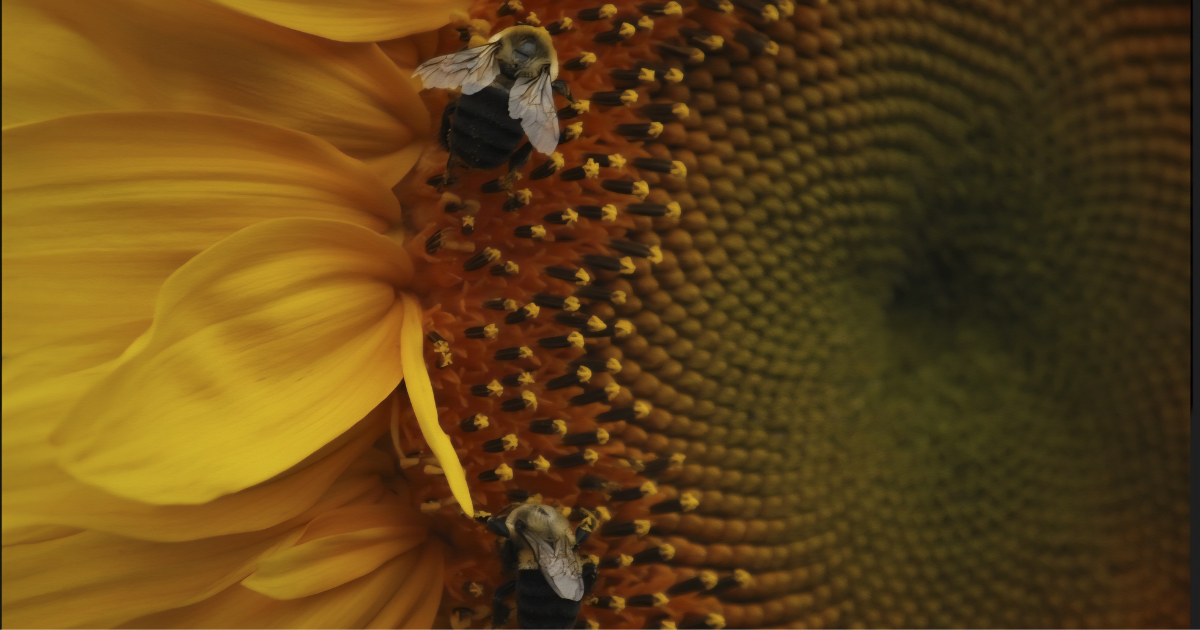
Before looking at the mathematics hidden in this sunflower, let’s begin with the story behind the photograph.
Pete Gariepy spent several days watching the sunflowers, waiting for a scene that would be more than the familiar image of a bee visiting a flower. The textures of the flower were his main focus, while the bees brought life to the scene.
As he describes it:
“I loved how the petal seemed to reach out to give its pollen to its visitor.”
— Pete Gariepy, Ottawa Photographer
He named the photograph “Lend a Helping Petal.”
Now let’s look at the same sunflower through a different lens.
Move your eyes away from the bee for a moment and toward the centre of the flower.
What do you notice?
Look closely at the tiny structures. Is their arrangement random—or can you detect a pattern?
.
.
,
Follow one of the curved lines with your eyes. It seems to wind around the centre. Now look again. Can you find another?
And what happens if you follow the curves in the other direction?
You may begin to see something remarkable: two families of spirals winding across the flower head.
Behind those spirals lies a fascinating intersection of biology, mathematics and physics.
,Z
One Flower……or Hundreds of Flowers?
A sunflower may look like one enormous flower, but botanically it is actually a flower head, or capitulum, made of many individual flowers called florets.
If this sounds familiar, you may remember our previous investigation, “One Flower, Three Insects… and a Hidden Secret.” There, we discovered something similar in the coneflower: what appears to be a single flower is actually a collection of many small florets.
Both sunflowers and coneflowers belong to the Asteraceae family, a group of plants characterized by this remarkable type of composite flower head.
In our previous investigation, we looked at those florets through the interactions between the flower and its insect visitors. This time, we are going to look at their arrangement—and discover the mathematics hidden within it.
This time, however, we are going to look at those tiny florets for a completely different reason:
How are so many of them organized into such a striking pattern?
That question takes us from biology into mathematics.
.
The Spirals We See
The conspicuous families of curved lines that we perceive across the flower head are called parastichies (spiral lines). They can usually be followed in two directions, forming clockwise and counterclockwise spiral families.
Importantly, these spirals are not structures that the plant first “draws” and then fills with florets.
Instead, they emerge from the spatial arrangement of many individual florets.
This is an example of an emergent pattern: large-scale organization arising from interactions occurring at a smaller scale.
To understand how such a pattern develops, we need to look at the science of plant arrangement.
.
Phyllotaxis: How Plants Organize Their Parts
The arrangement of leaves, flowers and other plant structures is called phyllotaxis.
Phyllotaxis has fascinated botanists, mathematicians and physicists for centuries because plant arrangements can display remarkable regularity.
Self-organization is central to modern explanations of phyllotaxis: large-scale order can emerge from local interactions among developing structures rather than from a pre-existing geometric template.
In a developing flower head, new floral structures begin as tiny primordia. Their positions are influenced by the structures and developmental processes around them.
Researchers have investigated several interacting mechanisms involved in this process, including biochemical signalling, interactions among neighbouring primordia, mechanical properties of growing tissues, and changes in the geometry of the developing flower head.
One particularly important biological signal is the plant hormone auxin.
.
Auxin: From Chemical Signal to Emerging Pattern
Auxin is a plant hormone, a chemical signal that helps regulate many aspects of plant growth and development, including where new organs begin to form.
In phyllotaxis, auxin is particularly important because its distribution is not uniform. Local regions of increased auxin activity can help determine where a new primordium, the early developmental stage of a new plant structure, will form. These changes can occur before the primordium becomes visibly distinguishable.
Research on gerbera, another member of the Asteraceae family, has also shown that flower-head patterning is closely associated with changes in the actively developing, or morphogenetically active, region as the head grows.
This gives us an important insight:
The mathematical organization that eventually becomes visible across a mature flower head begins with biological processes occurring much earlier during development.
And now we arrive at one of the most fascinating mathematical features of phyllotaxis.
This version also fixes a second accessibility issue: primordium is now explained when it appears in this section. The reader understands the sequence much better:
chemical signal (auxin) → location of new primordia → developing spatial arrangement → visible pattern.
.
The Golden Angle
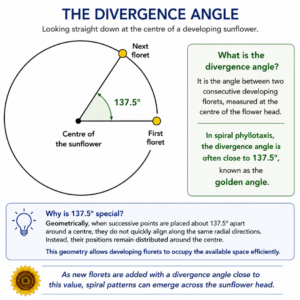
Imagine looking straight down at the centre of a developing sunflower.
One tiny new structure begins to form. Then another one begins.
Draw an imaginary line from the centre of the flower head to the first structure, and another line from the centre to the next one.
The angle between those two lines is called the divergence angle.
Another way to picture it is to imagine standing at the centre of a circle. Mark one position, turn around the centre, and mark the position of the next developing structure.
The amount you turned represents the divergence angle.
In spiral phyllotaxis, this angle is often close to:
137.5°
This particular angle is known as the golden angle.
But where does 137.5° come from?
.
Where Does the Golden Angle Come From?
The golden angle is mathematically related to another famous number: the golden ratio.
Imagine dividing a line into a longer part, , and a shorter part, , so that:
In words:
The whole is to the longer part as the longer part is to the shorter part.
This relationship produces the golden ratio:
$$\phi=\frac{1+\sqrt{5}}{2}\approx1.618$$
When a circle is divided according to the golden ratio, it produces two angles of approximately:
137.5° and 222.5°
By convention, the smaller angle, 137.5°, is called the golden angle. Together, the two angles form a complete turn of 360°.
Mathematically, the golden angle can be written as:
$$\alpha=\frac{360^\circ}{\phi^2}\approx137.5^\circ$$
Why ?
Let represent the smaller angle and the larger angle. Since the two angles are in the golden ratio, . Together, they form a complete circle of .
$$
\begin{aligned}
L+S &= 360^\circ \\[4pt]
\phi S+S &= 360^\circ \\[4pt]
S(\phi+1) &= 360^\circ \\[4pt]
S\phi^2 &= 360^\circ \\[4pt]
S &= \frac{360^\circ}{\phi^2}\approx137.5^\circ
\end{aligned}
$$
The step from to comes from a special property of the golden ratio: . This is why appears in the formula for the golden angle.
,
Why Does the Golden Angle Matter?
The importance of 137.5° becomes easier to understand geometrically.
Imagine repeatedly positioning points around a circle.
Start with 90°.
Place one point, turn 90°, and place another. Continue doing this.
After four turns:
$$4\times90^\circ=360^\circ$$
You return to the starting direction. As more points are added, they repeatedly line up along the same radial directions.
Now repeat the process using approximately 137.5°.
The result is very different.
Successive positions do not quickly return to the same radial directions. Instead, they remain distributed around the centre.
This geometry allows developing structures to occupy the available space efficiently.
.

.
This geometric property helps us understand why angles close to the golden angle appear so frequently in mathematical models of spiral phyllotaxis.
,
Fibonacci Appears
Now let’s return to the spirals we can actually see.
Remember the two families of parastichies—one clockwise and one counterclockwise?
Scientists can count them.
And something remarkable frequently occurs.
A sunflower seedhead might have 34 spirals in one direction and 55 in the other.
Another might display 55 and 89.
Look at those numbers:
$$1,\ 1,\ 2,\ 3,\ 5,\ 8,\ 13,\ 21,\ 34,\ 55,\ 89,\ldots$$
They belong to the Fibonacci sequence.
Beginning with 1 and 1, each number is obtained by adding the two preceding numbers:
$$
\begin{aligned}
1+1 &= 2\\
1+2 &= 3\\
2+3 &= 5\\
3+5 &= 8
\end{aligned}
$$
The sequence continues in the same way.
In many sunflower seedheads, the numbers of clockwise and counterclockwise parastichies often correspond to consecutive Fibonacci numbers.
But Fibonacci numbers and the golden angle have not appeared independently.
There is a deeper mathematical connection between them.
.
How Are Fibonacci Numbers, the Golden Ratio and the Golden Angle Connected?
Take two consecutive Fibonacci numbers and divide the larger by the smaller:
$$
\begin{aligned}
\frac{13}{8} &= 1.625\\
\frac{21}{13} &\approx 1.615\\
\frac{34}{21} &\approx 1.619\\
\frac{55}{34} &\approx 1.618
\end{aligned}
$$
As the Fibonacci numbers become larger, the ratio of consecutive terms approaches the golden ratio:
So we have our first mathematical relationship:
Fibonacci sequence → golden ratio
The golden angle is related to that same golden ratio:
$$\alpha=\frac{360^\circ}{\phi^2}\approx137.5^\circ$$
giving us another relationship:
golden ratio → golden angle
Together:
Fibonacci sequence → golden ratio → golden angle
However, the arrows here represent mathematical relationships, not a biological chain of cause and effect.
The sunflower is not calculating Fibonacci numbers and then using them to determine an angle. Rather, these mathematical quantities provide ways of describing and modelling patterns that emerge during plant development.
.
But Do All Sunflower Seedheads Show Fibonacci Patterns?
No.
And this is an important part of the story.
When we see photographs of highly regular sunflower seedheads, it can be tempting to assume that every sunflower follows the same mathematical pattern.
Real sunflower seedheads are more variable.
In a large citizen-science study, researchers examined 657 sunflower seedheads to investigate how frequently Fibonacci structure actually occurs.
In their most reliable dataset, they assessed 768 clockwise or counterclockwise parastichy counts. Of these, 565 were Fibonacci numbers, while another 67 showed a predefined type of Fibonacci structure.
But the researchers also documented non-Fibonacci structures, approximately Fibonacci patterns, more complex arrangements, and quasi-regular seedheads for which no single parastichy number could be assigned confidently.
This distinction matters.
Rather than saying:
“Sunflowers follow the Fibonacci sequence.”
a more scientifically accurate statement is:
The numbers of spirals visible in sunflower seedheads often correspond to Fibonacci numbers, but not every sunflower develops a regular Fibonacci pattern.
These departures from the familiar pattern are not merely imperfections. They provide valuable information for testing mathematical and biological models of how phyllotactic patterns develop.
.
Can Mathematics Describe the Shape of the Spirals?
So far, we have considered the angle between successive developing structures and the number of visible spirals. But there is another feature we can investigate mathematically: their shape.
To describe and study spiral geometry, mathematicians use mathematical curves as models. One important example is the logarithmic spiral.
What Is a Logarithmic Spiral?
A logarithmic spiral is a mathematical curve that becomes progressively farther from its centre as it turns.
For equal amounts of rotation, its distance from the centre changes by the same proportion, rather than by the same fixed distance.
As the curve moves outward, the spacing between successive turns therefore becomes progressively larger.
.

,
Logarithmic spirals provide one mathematical way of exploring and modelling spiral geometry.
However, the visible parastichies of a real sunflower should not automatically be interpreted as perfect logarithmic spirals.
They emerge from a growing biological system whose geometry and developmental conditions change over time.
The diagram above therefore shows a mathematical model superimposed on a sunflower, not a claim that the florets lie exactly on those mathematical curves.
This distinction is important when studying mathematical patterns in nature:
Mathematical models help us describe and investigate nature; nature does not have to reproduce an ideal mathematical object perfectly.
.
A Living Organism Is Not a Perfect Diagram
A sunflower is alive.
Its cells grow. Tissues change shape. Chemical signals fluctuate. Developmental events do not always occur with identical timing.
Living systems therefore exhibit stochastic variability—natural fluctuations sometimes referred to as biological “noise.”
Researchers have incorporated such variability into mathematical models of phyllotaxis to investigate how it affects otherwise regular patterns.
One interesting example involves the timing of primordium formation.
In a regular sequence, one primordium is initiated and then another follows. But sometimes two primordia may begin developing at nearly the same time.
When this happens, their ordering can become ambiguous, altering the sequence of divergence angles.
Models incorporating this kind of variability can reproduce some of the alterations observed experimentally in real plants, including sunflower.
This changes how we might think about irregularity.
Perhaps the surprising thing is not that some sunflower seedheads depart from an ideal Fibonacci arrangement.
A more interesting scientific question may be:
How does a living system, with all its natural variability, produce such remarkable regularity so often?
.
The Pattern Develops With the Flower
There is another important misconception to avoid.
The sunflower’s pattern is not simply stamped onto the flower head at the beginning.
It develops.
As new structures form and the flower head grows, the geometry of the actively developing region changes.
Mathematical and computational models of phyllotaxis can reproduce transitions in spiral organization as development proceeds. Different parastichy pairs can become prominent at different stages.
The pattern we admire in a mature sunflower is therefore the visible result of a dynamic developmental process.
.
Does the Sunflower “Know” Mathematics?
Of course not.
A sunflower does not calculate Fibonacci numbers, measure a divergence angle or construct a mathematical spiral.
Biological and physical processes generate the pattern; mathematics allows us to describe, quantify and model it.
Local interactions among developing structures, biochemical signalling, tissue growth and changing geometry contribute to the organization of the flower head. From these processes, large-scale patterns emerge.
When we examine those patterns mathematically, remarkable relationships become visible: divergence angles close to the golden angle, parastichy counts that often correspond to Fibonacci numbers, and spiral geometries that can be investigated through mathematical models.
The mathematics does not instruct the sunflower how to grow.
It gives us a language for investigating the order that emerges as the sunflower grows.
And sunflower heads displayed these patterns long before humans gave names to Fibonacci numbers, the golden ratio or the golden angle.
Nature came first. Mathematics helps us investigate what we observe.
.
Scientists Are Still Learning
Phyllotaxis has fascinated scientists for centuries, yet important questions remain.
Researchers continue to investigate how biochemical signalling interacts with mechanics, how primordia influence one another, how the geometry of a growing flower head affects the emerging pattern, why Fibonacci structures occur so frequently, and why some flower heads depart from them.
Modern phyllotaxis research therefore brings together botany, developmental biology, mathematics, physics and computational modelling.
A familiar sunflower turns out to be a remarkably sophisticated scientific problem.
.
One Sunflower, Many Ways of Seeing
Let’s return once more to “Lend a Helping Petal.”
Pete Gariepy looked at this sunflower and noticed its textures, its visiting bees and a petal that seemed to reach toward its visitor.
A biologist may look at the same sunflower and notice florets, primordia and developmental signals.
A mathematician may notice divergence angles, Fibonacci numbers and spiral geometry.
A physicist may ask how forces and interactions among growing structures contribute to the pattern.
An artist may notice light, texture, colour, form and the relationship between the flower and its visitor.
And a child might simply look closely and ask:
Why does it look like that?
That simple question can open the door to all of them.
The next time you see a sunflower in a garden or park, admire the yellow petals and watch the insects visiting it.
But then move closer.
Look at the centre.
Follow a spiral.
Then follow one in the other direction.
Try counting them.
And remember that behind what looks like a beautiful pattern is a developing living system—and an extraordinary intersection of art, biology, mathematics and physics.
Pete Gariepy’s photograph captures that intersection beautifully. “Lend a Helping Petal” has been sold at art shows in Ottawa, where visitors first encountered it as art. Yet the same image invites us to look closer and discover the biology, mathematics and physics hidden within the sunflower.
Sometimes, a scientific investigation begins simply by looking closely enough to notice that there is something to ask about.
.
Further Reading & Research
Swinton, J., & Ochu, E. (2016). Novel Fibonacci and non-Fibonacci structure in the sunflower: results of a citizen science experiment. Royal Society Open Science, 3, 160091.
This large citizen-science study examined 657 sunflower seedheads and documented Fibonacci, non-Fibonacci and more complex structures. It is particularly useful for understanding why the statement that all sunflowers “follow Fibonacci” is an oversimplification.
Mirabet, V., Besnard, F., Vernoux, T., & Boudaoud, A. (2012). Noise and Robustness in Phyllotaxis. PLOS Computational Biology, 8(2), e1002389.
This open-access study investigates how regular phyllotactic patterns can emerge despite natural stochastic variability and examines spiral phyllotaxis, divergence angles, self-organization and developmental “noise.”
Zhang, T., Cieslak, M., Owens, A., Wang, F., Broholm, S. K., Teeri, T. H., Elomaa, P., & Prusinkiewicz, P. (2021). Phyllotactic patterning of gerbera flower heads. Proceedings of the National Academy of Sciences, 118(13), e2016304118.
This research examines flower-head pattern formation in gerbera, another member of the Asteraceae family, combining developmental observations with mathematical and computational modelling.